Booking choice: The Skjervøy RIB day, from $334 per person. Check dates Tour details
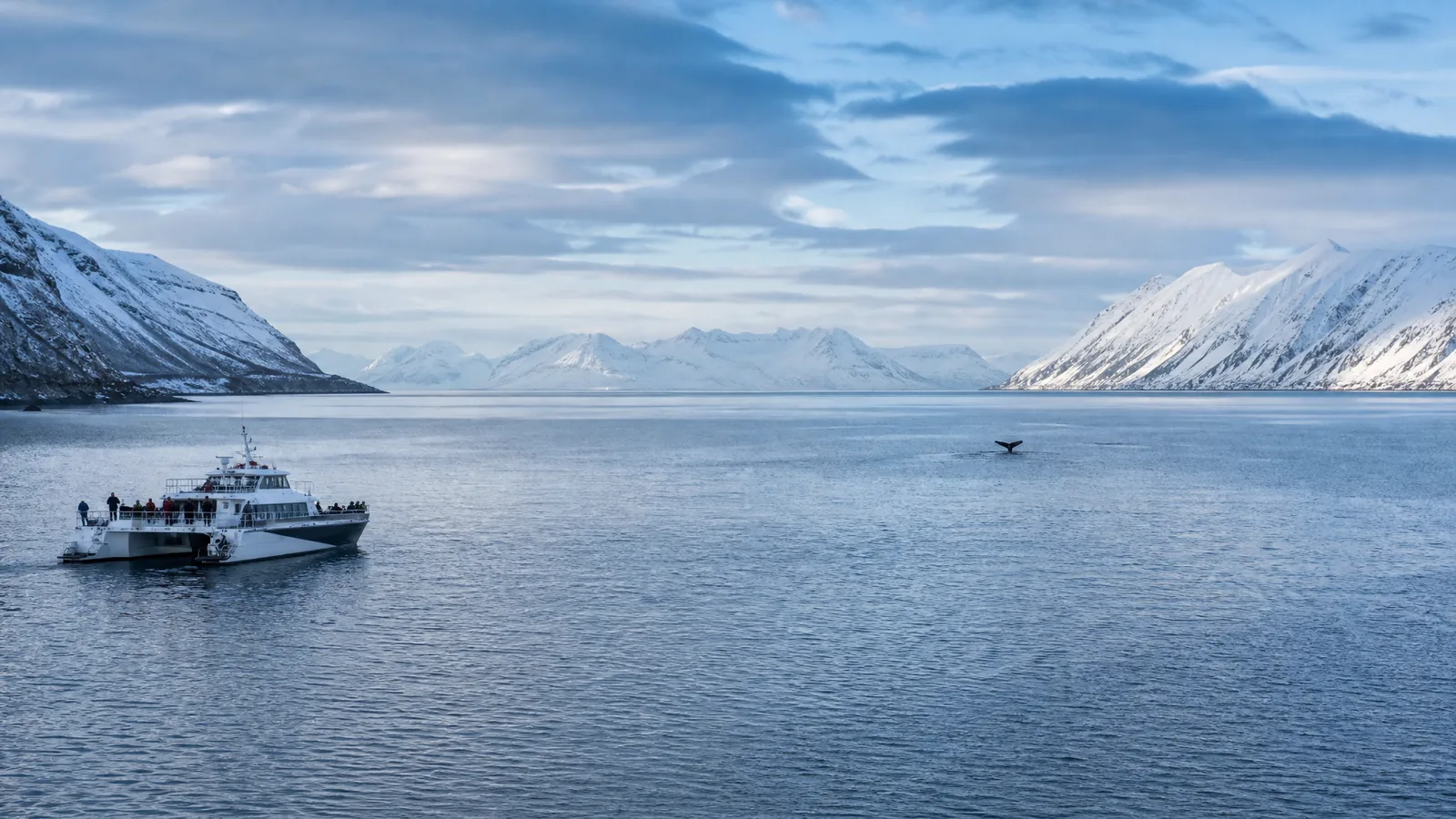
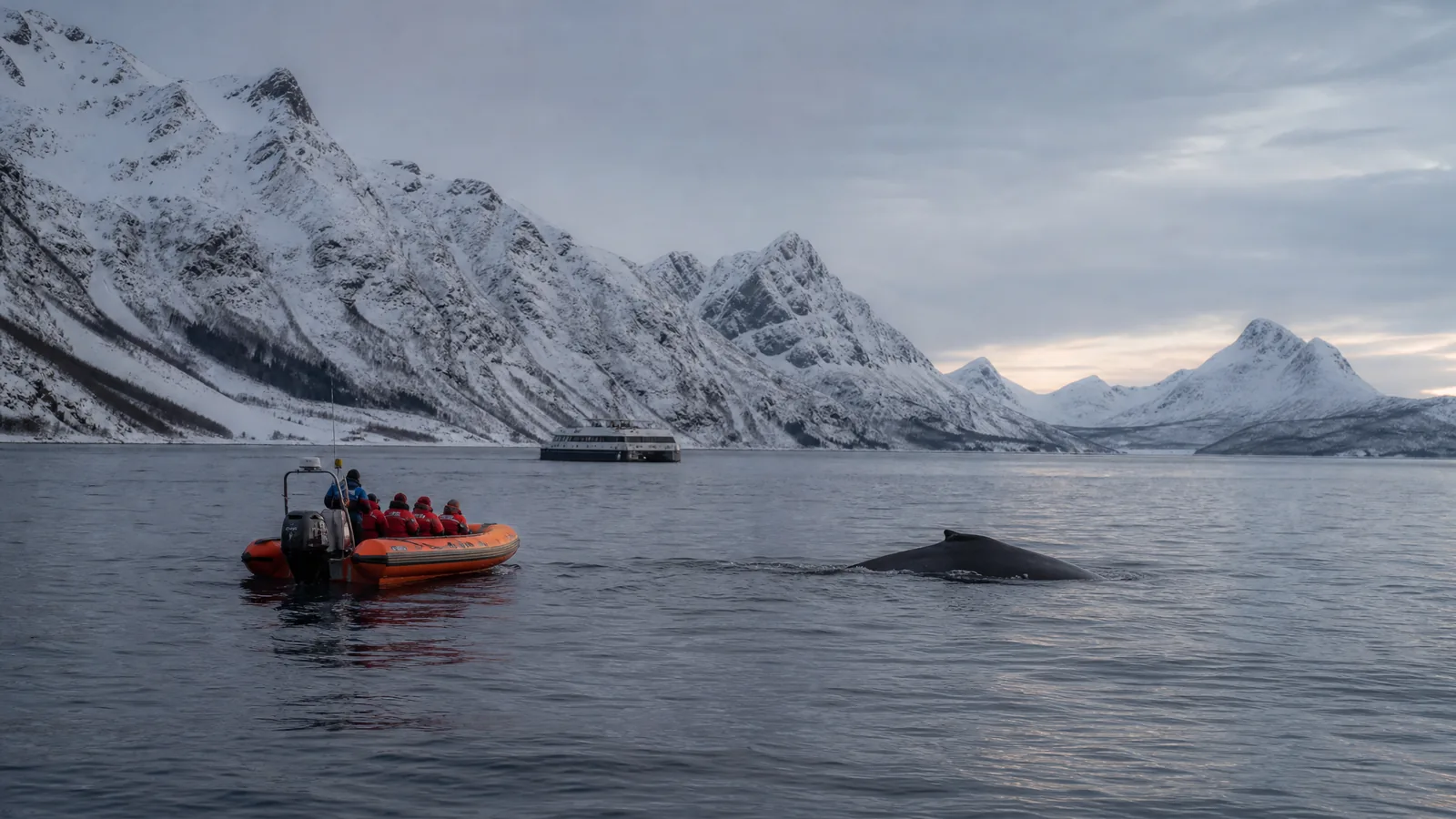
Two kinds of whale trips run from Tromsø. Big catamarans and hybrid boats leave the city harbour and sail 3 to 3.5 hours each way to the whales. RIBs, open rigid-inflatable speedboats with about 12 seats, start in Skjervøy after a 4-hour bus ride and stay out for 2.5 to 3 hours. A third kind, a small covered and heated boat at Skjervøy, sits between them.
Neither is better across the board. The right one depends on who is coming, how you handle cold and swell, and whether you want the closest view or the easiest day.
The quick answer
Choose a RIB if you are over 14, fit, not pregnant and want the longest, lowest view of the whales; it means a 05:00 bus and nearly three hours in a flotation suit. Choose a catamaran for children, older travellers, bad backs or a warm lounge, and accept about 1 to 2 hours near the whales. The heated covered boat at Skjervøy is the middle road.
What is the difference between a RIB and a catamaran?
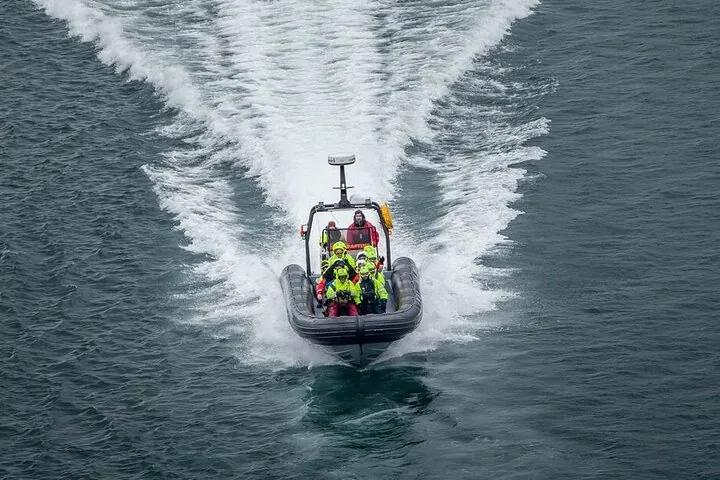
Size, shelter and where they start: a 12-seat open speedboat from Skjervøy, or a heated boat for 50 to 170 guests from central Tromsø.
Here are the three boat types side by side, each with the most booked trip of its kind.
| RIB at Skjervøy | Big boat from Tromsø | Covered boat at Skjervøy | |
|---|---|---|---|
| Example | Skjervøy RIB day | High-speed catamaran | Heated boat |
| Guests per boat | About 12 | 50 to 170 | Small group |
| Start | 05:00 bus, about 4 hours | 07:45 to 09:00 from the harbour | Early bus from Prostneset |
| On the water | 2.5 to 3 hours | 6 to 9 hours | 3 to 3.5 hours |
| Near the whales | Most of the boat time | About 1 to 2 hours | Most of the boat time |
| Shelter | None; flotation suit | Heated lounge and decks | Heated cabin and open deck |
| Ages | 14+, min. 140 cm | All ages on most | 6+, not pregnant |
| From | $334 | $197 | $381 |
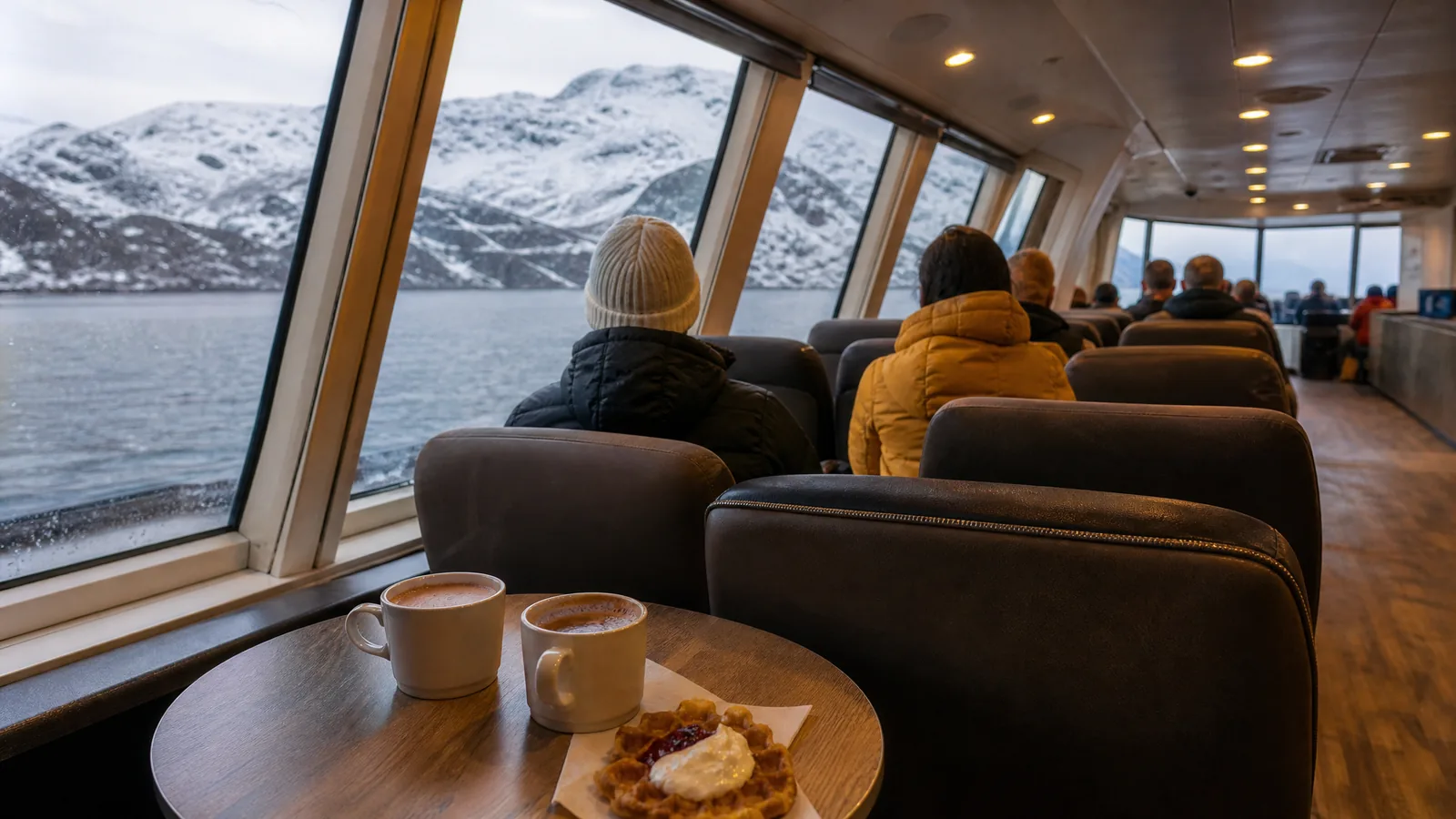
The time difference is the big one. A RIB spends almost all of its time in the whale area because the bus has already done the travelling. A catamaran spends most of its day sailing, past the Lyngen Alps, with a warm seat and a coffee.
Which gets you closer to the whales?
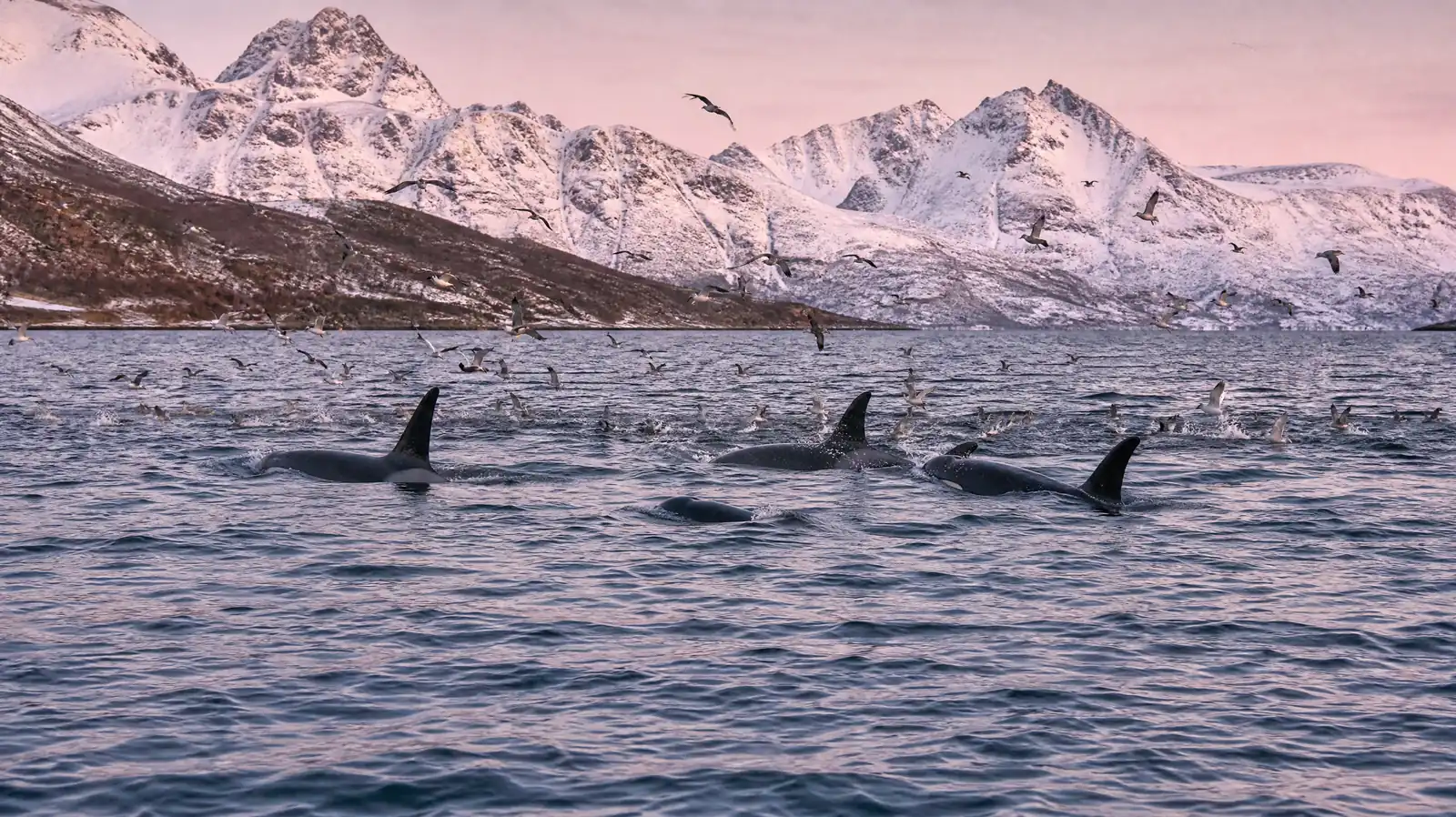
The RIB, mostly in eye level rather than distance. Every boat is asked to follow the same approach guidelines.
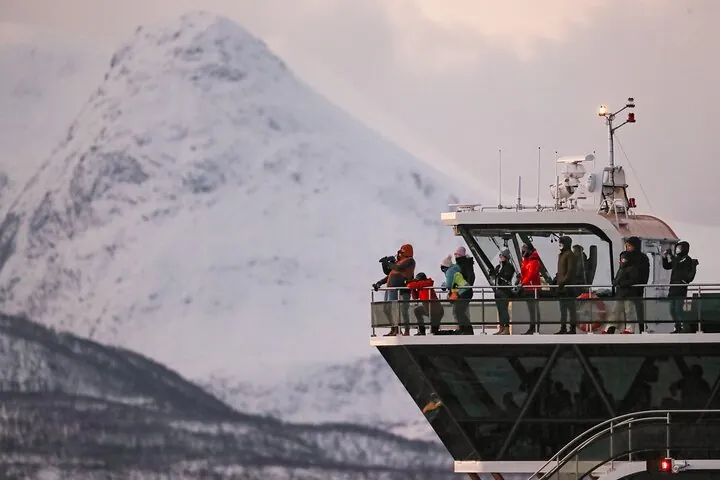
The Visit Tromsø guidelines apply to every hull: under 5 knots within 300 m of whales, minimum speed from 100 m, idle from 50 m, and no more than three boats on one group. What changes is your height. In a RIB you sit just above the waterline and an orca's fin can stand taller than you. From a catamaran deck you look down on the whales from several metres up, which shows more of the pod and less of each animal.
Whales sometimes swim up to boats on their own, and on a RIB that is the moment people remember. Closer is not always better for the animals, and guests notice. On the Skjervøy RIB day one wrote that the guide "kept reminding us to respect whales; closers aren't always better because it might disturb them." A guest on the heated boat was blunter about other operators: "Yes - the rib boats get much closer to the whales but that was visibly stressing them out". That is one person's view from one day, but it is worth reading our guide to ethical whale watching before you pick.
Which is colder?
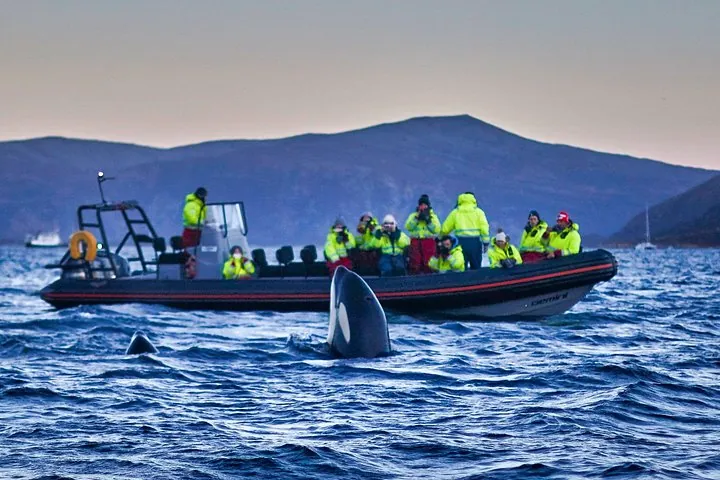
The RIB, by a long way: spray, wind from the boat's own speed and nearly three hours with no roof.
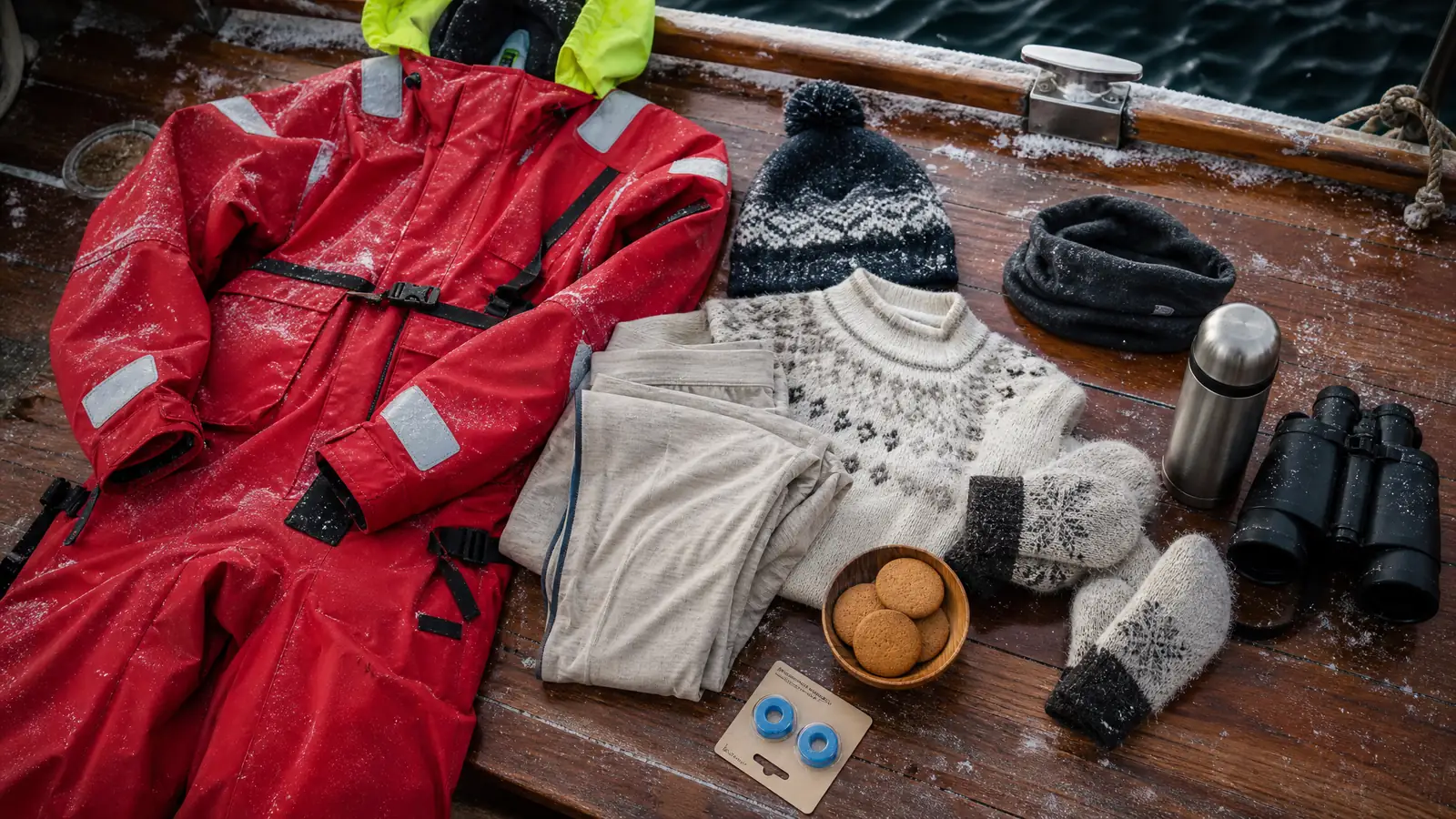
The RIB operators lend a flotation suit, boots, mittens and goggles. The Skjervøy RIB day listing still tells you to "DRESS WARM FROM HOME in layers", in capitals. Guests agree. On the Frozen Frontiers RIB: "You get quite a bit of water on the dinghy, so it's highly recommended to dress in layers. We kept our ski pants on under the suit they provided, and we were pretty comfortable." On another Skjervøy RIB: "I should have heeded the recommendation to bring a second pair of pants, as the suit isn't 100% waterproof."
On a big boat the cold comes in doses. You stand on the outdoor deck while the whales are up, then go inside to thaw. A guest on the covered boat summed up the difference: "Having the inside part of the boat was also extremely good as I don't think I would survive in the open cold for that long a time like with the other rafts." Either way you need real winter layers; our clothing guide goes through them.
Which is worse for seasickness?
Both can be rough. Big boats cross open water for longer; RIBs slam harder at speed and roll when they stop near the whales.
Seasickness comes up again and again in reviews of the big boats, mostly on the open stretch on the way out and in late January, when boats head into open sea. On MS Alba in January 2026: "please take a travel pill, it was very shaky and almost the whole boat threw up." On Brim Explorer the same month, one guest found it "very bumpy", while another was "only a little choppy for about 20 minutes when in open water. I took sea sickness tablets and was fine."
RIBs are not a cure. One RIB guest wrote: "Be prepared for the seasickness, which gets really bad when floating on the sea." The Frozen Frontiers RIB, the all-inclusive safari, the Helgøy catamaran and MS Alba all list people prone to seasickness as unsuited.
What helps, from Brim Explorer and the NHS: a small breakfast, ginger, fresh air, a seat low down and towards the back of a big boat, eyes on the horizon, no screens, and tablets taken before you board, not after you feel ill.
Who can't go on a RIB?
On most Skjervøy RIBs: anyone under 14 or under 140 cm, pregnant travellers and people with back problems.
The restrictions are there because a RIB slams over waves at speed. These are the limits each listing gives:
| Tour | Minimum age | Not suitable for (listing) |
|---|---|---|
| Skjervøy RIB day | 14, min. 140 cm | Pregnant women, back problems |
| Frozen Frontiers RIB | 14, min. 140 cm | Pregnant women, back problems, limited mobility, seasickness, low fitness |
| Arctic Explorers RIB | Min. 140 cm | Back problems, pregnancy |
| Heated boat | 6 | Pregnant women |
| All-inclusive safari | 4 | Limited mobility, seasickness, recent surgery, over 70 |
| High-speed catamaran | All ages | Wheelchair users |
| Brim Explorer | All ages | Wheelchair and stroller accessible (Viator) |
Two surprises. The all-inclusive boat lists people over 70 as unsuited, which rules it out for many couples who would be fine on a catamaran. And Brim's boats are the only ones described as wheelchair accessible. One Skjervøy RIB listing also excludes people over 120 kg; check the suit sizes if that applies to you.
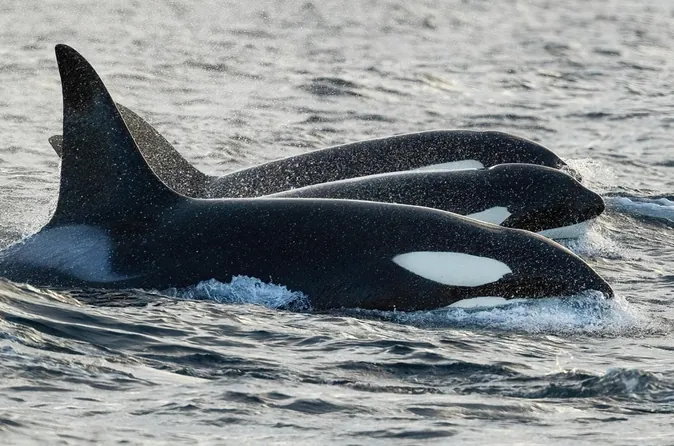
Close to the whales at Skjervøy without the flotation suit: a covered, heated boat with an open deck, 3 to 3.5 hours on the water, from age 6.
Check dates Tour detailsWhich is better for photos?
The RIB for low, eye-level shots; the big boat for a steadier, higher platform and long lenses, if you get a spot at the rail.
RIB photos look like nothing else: a fin at eye level, spray, mountains behind. The catch is your hands. You will be in a suit and mittens, the boat moves, and the RIB listing says any camera gear on board is at your own risk and should sit in a waterproof bag. One guest found "rubber gloves were very cold but not big enough to put your own gloves in". Thin liner gloves under the mittens solve most of it.
Big boats give you a steadier platform and more room for a long lens, if you claim your space. A catamaran guest in January 2026 missed the humpbacks on camera because "the spots along the railing were already taken, and you had to hold on tight at the same time." Brim's three outdoor decks help here. Drones are banned on both the catamaran and the Skjervøy RIB.
In polar night the light is low on every boat. A fast lens matters more than the boat you choose.
Which should you choose?
A RIB for fit adults who want the most whale time; a catamaran for families, comfort and anyone unsure; the heated boat for Skjervøy without the suit.
- First whale trip, children, or doubts about the cold: the high-speed catamaran from $197, or else Brim Explorer's silent boat, which switches to electric drive near the whales.
- Fit adults who want the closest view: the Skjervøy RIB day from $334, or the Frozen Frontiers RIB, which you can also join in Skjervøy without the bus.
- Skjervøy without the suit: the heated boat from $381, with a cabin to warm up in.
- Late January: a big boat with a rebooking guarantee. When the whales move to open sea, Skjervøy operators sometimes swap the RIB for a bigger boat; one guest got an email the day before saying exactly that.
Price is the last thing to weigh, not the first. Our price guide shows the cost per hour near the whales is close to even.
Frequently asked questions
Is a RIB safe for whale watching in winter?
The RIBs carry flotation suits, life vests and a skipper, and the Visit Tromsø guidelines cap trips at about 3 hours because of the cold. They are not suitable for pregnant travellers or anyone with back problems, because the boat slams over waves at speed.
Can children go on a RIB whale safari?
Not on most. The Skjervøy RIBs take no one under 14 or shorter than 140 cm. Families with younger children should pick a catamaran; the heated covered boat at Skjervøy takes children from 6.
Do catamarans provide thermal suits?
Most don't, so you bring your own warm clothes. The all-inclusive Polar Adventures boat is the exception and lends thermal suits.
Which whale watching boat is quietest?
Brim Explorer's hybrid boats switch to electric drive near the whales to cut noise. Any boat can go into neutral when whales come close, and the guidelines ask all of them to.
Ready to book
Choose your boat
Free cancellation up to 24 hours before on every option. Prices are from-prices in USD and move with the season.
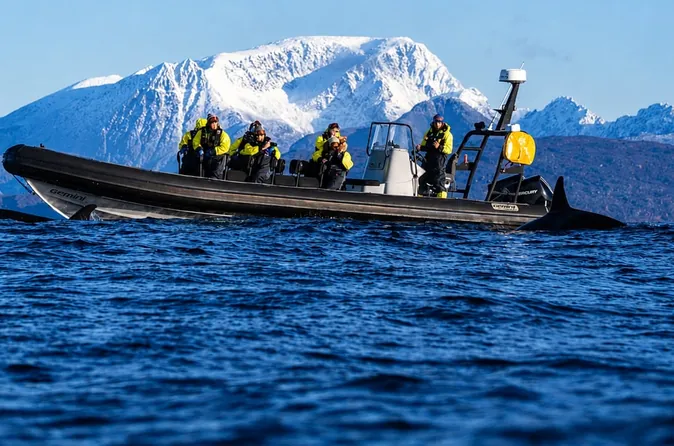
Skjervøy RIB Whale Watching Tour
- Bus from Scandic Ishavshotel to Skjervøy and back
- RIB boat trip with a skipper
- Thermal flotation suit, boots, mittens and goggles
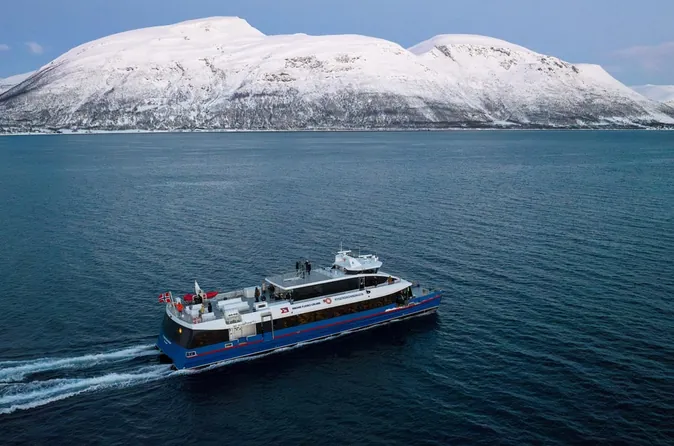
Whale Safari on a High-Speed Catamaran
- About 8 hours return from central Tromsø
- Heated lounge with panoramic windows and a big outdoor deck
- Guides in English, German or Italian (by departure)
Orca & Whale Watching on a Heated Boat
Small covered boat at Skjervøy, no flotation suit needed